
What gets measured gets managed.
Email scoring typically refers to methods used to evaluate various aspects of email campaigns or the characteristics of email recipients.
The key is understanding what each score actually means.
Below is a comprehensive list of email scores along with brief descriptions of their purpose:
- Email Deliverability Score: Assesses the likelihood of an email reaching the recipient’s inbox instead of being marked as spam or bouncing back.
- Email Engagement Score: Measures how recipients interact with your email campaigns, serving as a critical indicator of the effectiveness and relevance of your content to your audience.
- Email Content Score: Evaluates the quality and effectiveness of the content within an email, helping marketers determine how well their email content is likely to perform in terms of engaging recipients and prompting action.
- Sender Reputation Score: A crucial metric used by Internet Service Providers and email services to assess the trustworthiness of an email sender, influencing whether your emails land in inboxes or spam folders.
- Email Spam Score: Determines the likelihood of an email being perceived as spam by servers and filtering systems.
- Email Lead Scoring: A specialized application of lead scoring for ecommerce businesses, assigning scores to leads based on their interactions with email campaigns and behavior on the ecommerce website.
- Email List Quality Score: Assesses the health and effectiveness of an email list by evaluating attributes such as the accuracy of email addresses, subscriber engagement, and the likelihood of emails reaching the inbox.
After reviewing this extensive list, you might wonder why email marketers would need yet another email score.
The answer is simple: all the scores above are email-centric, failing to grade the performance of email-driven traffic in the online store—the most important element of the buyer journey where success is ultimately determined.
New Type of Score: Email Uplift Score
The Email Uplift Score is a credit-like score used to evaluate the effectiveness of email marketing campaigns specifically within your online store.
Unlike other scores that compare against market averages, this score is modeled on the intrinsic potential of your own brand.
It helps businesses assess how well their email strategies drive sales, engage customers, and build loyalty relative to their internal potential.
The score is calculated through uplift modeling of email shoppers at various stages of their customer lifecycle. It is provided as a total score along with lifecycle stage sub-scores, helping you assess whether your email marketing is performing well and identify any weak links in the customer lifecycle.
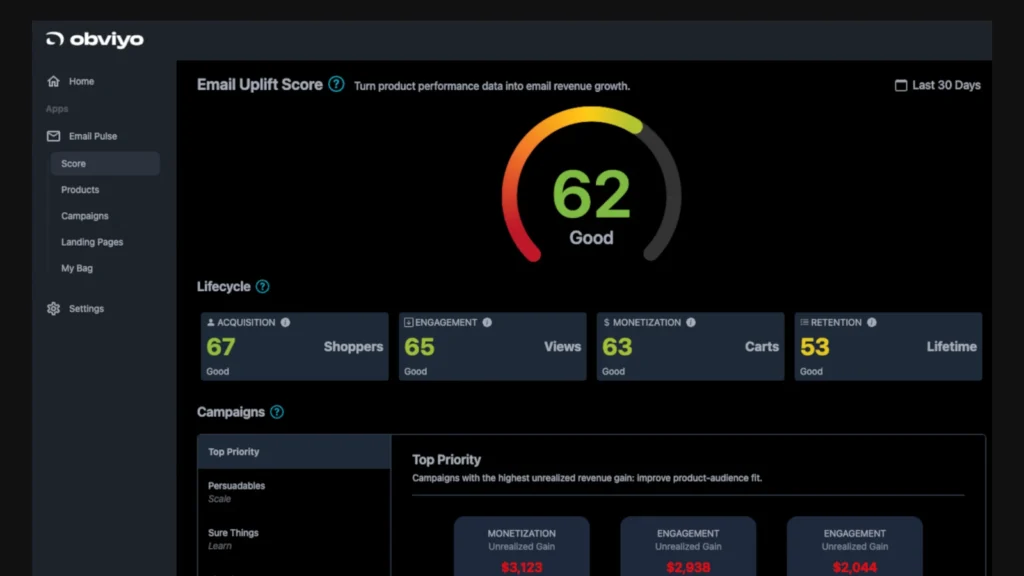
Score Details
The logic behind the Email Uplift Score is straightforward: since you have more detailed information about your email list contacts and can market directly to them, email shoppers should outperform random similar visitors to your store.
A score of 50 indicates that your email marketing performance is on par with the performance of other similar visitors to your store.
Here are additional details about lifecycle sub-scores:
- Acquisition: This score assesses the quality of email shoppers’ performance in your online store. It is based on the engaged session rate (10+ seconds on the site, 2+ page views, or at least one conversion event) and revenue per engaged session.
- Engagement: This score indicates whether you are driving email traffic to relevant landing pages. It is calculated based on the average page views per landing page and revenue per page view.
- Monetization: This measures the success of your email campaigns in generating revenue. It is based on the shopper cart rate and average revenue per add-to-cart event.
- Retention: This score is a direct indicator of your ability to retain contacts in your email list. It is based on the average number of lifetime days since the first store visit and revenue per lifetime day.
Use Cases
The Email Uplift Score is a key feature of our Email Pulse application, available free of charge at all times.
It includes AI-generated insights about your campaigns, landing pages, and products, empowering you to elevate your email marketing performance in your online store to the next level.
Here are a few ways you can achieve that:
- Monitoring: Instantly generated scores and additional metrics let you know if your marketing strategies are performing as expected.
- Prioritization: Quantifies the impact of underperforming campaigns, helping you identify the biggest losers that need immediate attention.
- Recommendations: AI-generated product suggestions tailored to perform better with your target audience.
- Implementation: Automatically generated HTML versions of product recommendations that you can easily copy and paste into a new email.
Conclusion
Ecommerce email marketing scores are essential tools for assessing the effectiveness of your email campaigns.
They provide crucial insights into various metrics such as deliverability, open rates, click-through rates, and conversion rates, which collectively reflect the health and impact of your email strategies.
By continually monitoring and improving these scores, businesses can enhance the precision and effectiveness of their marketing efforts, leading to higher engagement, increased conversions, and ultimately, boosted revenue.
In a competitive digital marketplace, understanding and improving your email marketing scores is not just beneficial—it is imperative for staying ahead and achieving sustained growth.
How important is ecommerce email score?
The Ecommerce Email Score is extremely important in assessing the effectiveness of email marketing strategies within an ecommerce context.
Assessing Campaign Effectiveness The Ecommerce Email Score provides a comprehensive overview of how well your email campaigns are performing. It measures factors like deliverability, open rates, click-through rates, conversion rates, and overall engagement, giving you a holistic view of your email marketing efforts.
Driving Revenue For ecommerce businesses, email marketing is a direct channel to drive sales. A good email score often correlates with higher conversion rates and increased revenue. It signifies that your emails are not only reaching the inbox but also compelling enough to drive purchases.
Improving Customer Retention Effective email marketing nurtures customer relationships, encouraging repeat business and increasing customer lifetime value. A high email score indicates that your campaigns are resonating with customers, keeping them engaged and connected to your brand.
Optimization and Personalization Monitoring your email score helps identify what aspects of your email strategy are working and what areas need improvement. This ongoing optimization process allows for better personalization, making each communication more relevant to the individual recipient.
Resource Allocation Understanding the performance of your email campaigns through the Ecommerce Email Score enables smarter allocation of marketing resources. By investing more in high-performing strategies and revising underperforming ones, you can more efficiently use your marketing budget.
Competitive Advantage In the crowded ecommerce landscape, businesses that effectively use email to reach their customers have a competitive advantage. A strong email score reflects your ability to cut through the noise and capture the attention of your audience.
Overall, the Ecommerce Email Score is a vital metric that helps businesses evaluate the impact of their email marketing campaigns. It can guide in fine-tuning strategies to enhance customer engagement, improve conversions, and ultimately drive business growth.
How to improve ecommerce email score?
Improving your ecommerce email score involves optimizing various aspects of your email marketing strategy to enhance deliverability, engagement, and conversions.
Segment Your Email List Segment your list based on customer behavior, demographics, purchase history, and other relevant criteria. This allows you to send more targeted and relevant emails, which can lead to higher open and click-through rates.
Personalize Your Emails Go beyond just using the recipient’s name. Personalize content based on the customer’s past interactions, preferences, and purchase history. Tailored recommendations and personalized promotions are more likely to engage customers and drive conversions.
Optimize Email Content Ensure that your emails are visually appealing and treated as an ecommerce web page that incorporates a broad range of product discovery strategies. Use a responsive design so that your emails look good on all devices. Include engaging and relevant content that provides value to the reader, such as exclusive offers, useful tips, or new product announcements.
Increase Engagement Metrics Encourage your subscribers to interact with your emails. Include clear and compelling calls to action, use buttons for important links, and ensure that the links lead to relevant landing pages that are optimized for conversions.
Monitor and Analyze Performance Use analytics to track the performance of your email campaigns. Pay attention to metrics like open rates, click-through rates, conversion rates, and unsubscribe rates. Use these insights to continuously refine and improve your email strategies.
Re-engage Inactive Subscribers Implement re-engagement campaigns to bring back customers who have not interacted with your emails for a while. Offer them a special discount or remind them of the benefits of staying subscribed to your list.
Test and Experiment Continuously test different aspects of your email campaigns, such as sending times, email formats, and promotional offers. This experimentation can provide valuable data on what works best for your audience.
By implementing these strategies, you can improve your ecommerce email score, which in turn will help enhance the overall effectiveness of your email marketing efforts, driving more sales and strengthening customer relationships.
What is a good ecommerce email score?
A good ecommerce email score varies based on several factors including industry standards, the specific metrics used to calculate the score, and the goals of your email campaigns.
Open Rate For ecommerce, a good open rate typically falls between 15% and 25%. Higher rates suggest that your subject lines are effectively capturing attention.
Click-Through Rate (CTR) A good CTR for ecommerce emails generally ranges from 2% to 5%. This indicates that the content within the emails is engaging and successfully encourages recipients to take action.
Conversion Rate A conversion rate of 1% to 5% is generally considered good for ecommerce emails. This reflects the percentage of recipients who make a purchase after clicking through an email.
Revenue per Email This metric shows the direct revenue impact of each email sent. Any positive ROI indicates effectiveness.
Bounce Rate A low bounce rate is crucial for a good email score. Ideally, this should be less than 2%. Lower rates indicate that your email list is clean and well-maintained.
Unsubscribe Rate Ideally, this should be less than 0.5% per email sent. Keeping this rate low suggests that your content remains relevant and is not pushing subscribers away.
Spam Complaints Maintaining spam complaints at less than 0.1% is crucial. Lower rates reflect compliance with email marketing best practices and respect for subscribers’ preferences.
A good ecommerce email score combines these metrics to reflect high engagement, strong conversion rates, and overall effective email marketing practices. Regularly monitoring these benchmarks and adjusting your strategies based on the results can help maintain or improve your email score.
Additional articles about ecommerce email score
GetResponse — “Email Marketing for Ecommerce: 9-Step Strategy & Tips” This article offers a comprehensive guide to enhancing your ecommerce email marketing, including tips on timing emails right and using behavior-triggered campaigns, which can directly influence your ecommerce email score. Read the article on GetResponse
MailCharts — “Ecommerce Email Marketing: A Complete Guide” This guide dives into strategies for driving conversions through email marketing, discussing how a well-executed email campaign can result in significant visitor traffic and sales conversion. Explore the guide on MailCharts
Email Pulse — “7 Strategies to Supercharge Your Ecommerce Email Marketing” This post introduces product-led growth strategies for email marketing. By harnessing insights from online product performance, businesses can achieve sustainable and profitable growth. Read the article