Will this hurt my sender reputation? +
That is the exact risk Recharge is built around. It never blasts. It sets a safe daily volume from your own everyday sending, keeps recovery to a small share on top of it, validates every address before use, and watches your bounce, spam, and unsubscribe signals as it sends. On a warning it steps the pace down. On a real problem it pauses itself.
Is re-engaging a suppressed audience even legal? +
Suppression is something you did, and it stays under your control. An opt-out is something the user did, and it stays off-limits. Recharge only lifts a dormancy pause on people who opted in and never unsubscribed, bounced, or complained. It never overrides an opt-out and never manufactures consent. Every cycle is built as a draft you approve, and the coldest cycle is gated behind your own sign-off.
How does soft opt-in work in different countries? +
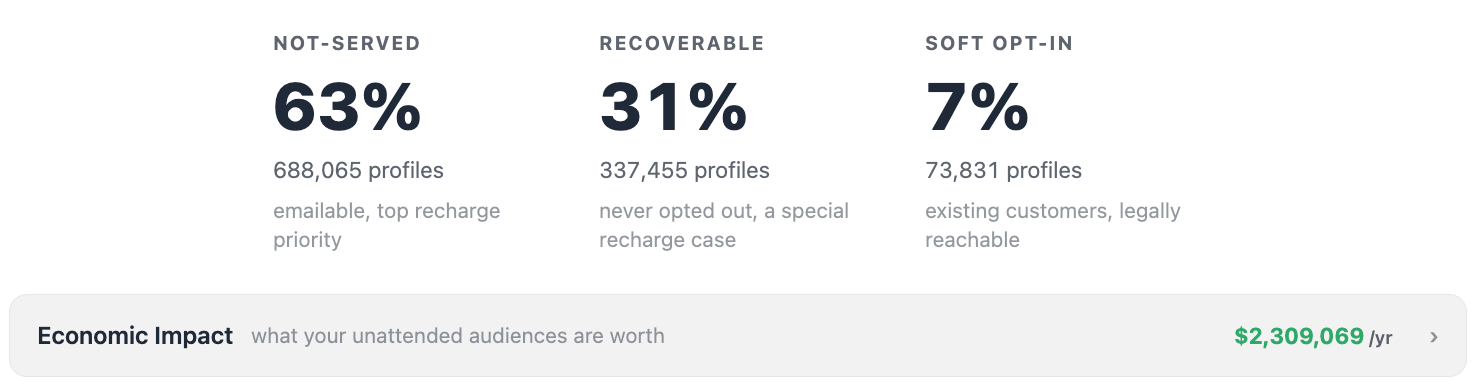
Most markets let you email your own past customers about products similar to what they bought without a fresh opt-in, though the conditions differ. The UK sets the strictest bar, under PECR: the contact came from a sale, the products are genuinely similar, and every message carries an easy opt-out. The EU applies a comparable existing-customer exemption. The US works on an opt-out basis under CAN-SPAM. Canada treats a purchase as implied consent for about two years. Australia infers consent from an existing customer relationship. Recharge builds to the strictest of these as its floor and keeps every message relevant to what the shopper bought. This is general information, not legal advice.
Does un-suppressing manufacture consent? +
No. It lifts a dormancy suppression on profiles whose consent never lapsed, and it verifies a clean, valid address first. Anyone who unsubscribed, hard-bounced, or complained stays suppressed. A purchase never overrides an unsubscribe.
How do you decide the daily volume? +
From your own sending health, not a generic tier. Recharge takes your proven everyday volume, allows recovery only as a small share on top, and discounts that further if your account is already stressed. Clean cycles let it raise the pace. Any red signal pulls it back.
How is a recovered profile counted? +
As a click back to your store, not an open. Opens became an unreliable signal once Apple started masking them, so a click is the honest measure that a shopper re-engaged.
Isn't this just a win-back flow? +
A win-back blasts everyone who already lapsed in a single batch. That concentrates the shoppers least likely to respond, which can trip the reputation systems at the inbox providers. Recharge does it the low-frequency way, dripping emails to the target audience over time while monitoring your reputation signals. It reaches a cold audience without wrecking your sender reputation. That pacing, monitoring, and self-correction is the safety layer that is not possible in Klaviyo today.
How is the recoverable value estimated? +
Off your own realized performance, not a generic benchmark. A live, emailable profile is worth your email-attributed revenue divided by your emailable profiles per year. An unattended profile is worth a fraction of that, based on how many reactivate and what they are worth once back. Both assumptions are visible and adjustable. It is a sizing estimate, not a promise.
Do I stay in control of what sends? +
Always. Recharge never flips a recovery flow live on its own. Every cycle is built as a draft inside your Klaviyo for you to review and activate. Nothing sends until you say so.
Does it run on my Klaviyo? +
Yes. Recharge builds real Klaviyo flows and segments, draft-first, and reports through Klaviyo's own numbers. Nothing to rip out, and nothing new for your team to learn.