Summary: “Product-Led Growth” (PLG) is a go-to-market strategy that has revolutionized the software industry and is now doing the same for ecommerce businesses.
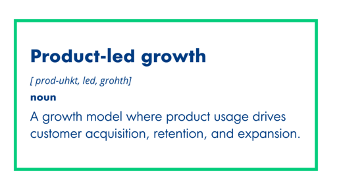
PLG streamlines processes, fosters enduring connections with shoppers, and utilizes data to steer business decisions, delivering unparalleled value:
- Enhanced product purchasing experiences
- Capital-efficient growth
- Accelerated growth
- Expanded market reach
The winners in the next phase of ecommerce evolution will redefine how they leverage their products as a growth engine, integrating PLG principles into their advertising, presentation, and monetization strategies.
How did we get here?
Ecommerce has evolved from an online distribution channel to become the connective tissue of the entire business, with digital experiences serving as the primary method of engaging with customers.
It enabled connecting consumers where they’re already spending time, whether that’s in-browser, in-app, on a mobile device, or even through a connected machine.
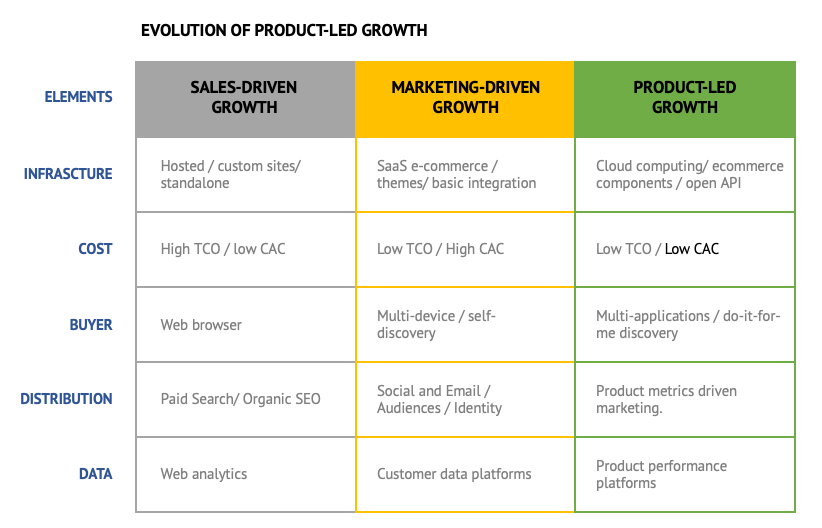
Trend 1 – Unsustainable customer acquisition cost (CAC)
According to research conducted by SimplicityDX, customer acquisition costs have surged by up to 60% over the past five years.
The exponential growth in the number of online stores has outpaced the expansion of ad placement capacity, leading to intense bidding wars and pushing customer acquisition costs to unsustainable highs.
This challenging situation has been exacerbated by various market developments, including:
- Google’s emergence as a paid search monopoly, contributing to additional price hikes in paid advertisements.
- Google’s disabling of keyword tracking, significantly reducing the effectiveness of SEO and paid-search campaign management.
- AI-driven advertisement algorithms prioritizing ad platform metrics over merchant revenue.
- iOS 14.5, which introduced privacy-focused changes that significantly impacted digital advertising.
- The phasing out of third-party cookies.
- Increased consumer privacy legislation, such as CCPA and GDPR.
Collectively, these factors have placed ecommerce marketers in a demanding predicament, compelling them to innovate new go-to-market strategies.
Trend 2 – Rise of social media
Social apps like Facebook, Instagram, and Twitter have revolutionized online experiences by offering simple, intuitive interfaces and continuously delivering tailored content aligned with users’ interests through smart algorithms.
This now establishes a new benchmark for online shopping experiences as well.
Online shoppers are now less inclined to use site navigation, search, or filtering options to discover products of interest. If a product isn’t directly displayed on a screen, it’s almost as if it doesn’t exist at all.
The next generation of ecommerce sites must go beyond pretty pixels and intuitive navigation to provide social app-like buying experiences.
Trend 3 – Identity resolution
A new breed of data vendors is providing the ability to capture the identity of anonymous shoppers visiting online stores.
Merchants are excited about the new ability to grow their email and text lists so they can reach out and continually engage with previously unreachable web visitors.
However, having more contacts by itself is not a solution. To monetize these new prospects, merchants need to have an increased ability to make their emails and texts more relevant to shoppers’ prior online behavior.
Trend 4 – AI is driving the next economic super cycle
AI is generating a level of excitement reminiscent of the early days of the Internet.
With its abundant treasure trove of customer and product data, the ecommerce landscape stands as a fertile ground for cultivating groundbreaking AI-powered applications.
This fusion of ecommerce and AI is not just a technological revolution — it’s a societal shift redefining the fabric of our commercial interactions. In this transformative era, AI’s integration within ecommerce operations is not merely an option but a necessity for sustained relevance and competitive advantage.
PLG Principles for AI-driven ecommerce
How can a company transition into a product-led growth (PLG) ecommerce company?
While there isn’t a single prescribed path to achieve PLG, we’ve compiled a set of principles to guide online brands in navigating this transformation.
You don’t need to adopt all principles listed below. Instead, use as many as are applicable to your brand. Start by embracing the Acquisition and Monetization principles — these are fundamental for a strong foundation. Then, integrate the Experience and Retention principles to further enhance and amplify your efforts.
1. Acquire based on product performance
Campaign → Product Performance
Conventional marketing traditionally revolves around crafting ad campaigns targeting audiences that yield the highest return on ad spend (ROAS).
However, with the advent of product feeds for shopping ads facilitated by Google and other platforms, the market potential has significantly expanded.
The Product-Led Growth methodology counters the trend of consolidated ad platform power by empowering marketers to actively manage their campaigns. PLG establishes a symbiotic relationship between ad platforms and merchants by complementing their respective strengths: driving traffic to websites (ad platforms) and leveraging product performance metrics (merchants).
By ensuring that ad campaign feeds promote top-performing products, merchants effectively reach audiences interested in products they are inclined to purchase.
Principle: Product performance metrics reign supreme. They serve as a powerful lever marketers can pull to attract high-intent shoppers to the online store.
2. Stage dynamic product discovery experiences
Design → Product Discovery
A visually appealing site design with a strong brand identity remains crucial, but it alone is insufficient to maintain a competitive edge today.
When over 90% of web visitors leave an average online store without adding any products to their shopping cart, the need for an enhanced product discovery experience becomes paramount.
Modern-day shoppers, accustomed to seamless experiences on social media apps, anticipate that online stores will effortlessly provide ways to discover products of interest automatically.
Product-led solutions are addressing this challenge by dramatically expanding a store’s shelf-space to showcase available products in various ways, targeting diverse buyer personas with unique product requirements.
Principle: Ensure your products are easily discoverable by employing various methods to display them effectively.
3. Monetize every visitor engagement
Conversion → Customer Behavior
The solution to anonymous shoppers with unknown product needs lies in utilizing product performance metrics.
As different buyers independently discover products, they leave behind engagement traces that serve as indicators for similar buyers to follow. The Product-Led Growth solution effectively captures these buying signals to connect the right product with the right buyer in real-time.
A noteworthy historical fact: Amazon was the first to recognize that visitor behavior is a better predictor of product preferences than historical data alone. This discovery by Amazon laid the foundation for the Product-Led Growth methodology in ecommerce.
Principle: Utilize live visitor actions as buying signals to dynamically display the right products in real-time.
4. Retain with relevant products
Audience → Product Relevance
With the rapid advancement in capturing contact information from anonymous online shoppers, the scope of retention campaigns has expanded to include those who have not yet converted into customers.
Product-Led Growth technology addresses the retention challenge by enabling the personalization of email and text communications based on product performance signals from prior store visits.
This approach creates relevance to products already purchased or viewed while also showcasing additional products that an individual may not be aware the brand offers.
Principle: Utilize product performance signals from prior engagements to enhance the relevance of retention campaigns.
Conclusion
Product-Led Growth in ecommerce embodies both a technological advancement and a mindset shift. Technological innovation is facilitated by high-resolution product performance data and real-time AI capabilities. The mindset shift centers on the counter-intuitive reality that product performance metrics constitute the next frontier for ecommerce growth.
You don’t need to build your product-led growth program from scratch. Email Pulse enables you to effortlessly lay the foundation for your future growth with instant access to product-led email retention capabilities.