Personalization: Familiar Word, Fuzzy Meaning
For some, email personalization simply means inserting the contact or company name into the subject line or body of the email—making it appear as though the message was written specifically for that recipient.
For others, it’s about triggering emails that remind shoppers of products they viewed or left in their cart, often by displaying those exact items in the message.
Today, these features are available in virtually every email platform and have largely become commoditized—their value increasingly up for debate. From the shopper’s perspective, they offer nothing truly new or useful. Shoppers already know their own name, and if a product they viewed or abandoned was important, they haven’t forgotten it.
Real personalization—and meaningful value for both shoppers and merchants—starts when emails deliver new, relevant, and unexpected content that speaks to a shopper’s actual interests or needs. That’s the kind of personalization that sparks curiosity, drives engagement, and builds lasting brand loyalty.
Klaviyo’s Product Feeds
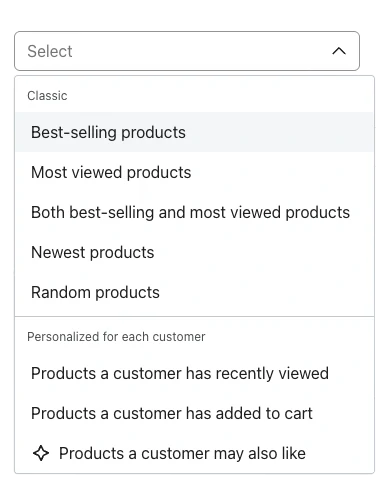
Klaviyo’s product feeds are the foundation of its email personalization capabilities, helping merchants surface products that shoppers are most likely to be interested in and ready to buy.
These feeds fall into two categories:
- Classic feeds surface the store’s most popular products—based on sales, views, or a combination of both—and are useful for general engagement.
- Personalized feeds, on the other hand, leverage Klaviyo’s event tracking to include products a specific customer has recently viewed or added to their cart, as well as more advanced options like the “Products a customer may also like” feed.
Many marketers see the “customer may also like” feed as a silver bullet for email personalization.
Giving Credit Where It’s Due
Klaviyo has been a true innovator in email marketing, pioneering dynamic product feeds and making event tracking in online stores both simple and powerful.
By enabling marketers to trigger automated emails based on real-time shopper behavior, Klaviyo set the stage for timely, relevant engagement.
These foundational capabilities now allow other application developers—like Email Pulse—to build on top of Klaviyo’s framework and deliver the next tier of personalized email shopping experiences.
Overcoming Klaviyo’s Limits
Klaviyo’s “Recommended for You” feed offers valuable personalization capabilities. It’s powered by a widely used collaborative filtering algorithm that generalizes recommendations based on aggregated shopper behavior—not true 1:1 personalization (see ChatGPT research).
In that sense, it’s a helpful starting point, but far from the most advanced approach available. Below, we outline its key limitations and explain how Email Pulse expands on this foundation to unlock deeper personalization and greater impact.
1. Intelligence
Limitation: Single Algorithm As mentioned earlier, Klaviyo offers just one personalized recommendation feed, powered by what is now considered legacy technology. It’s built to handle only a narrow range of buying scenarios—typically tied to the last product viewed or added to the cart—limiting its ability to deliver broader relevance.
Next Level: Generative AI Email Pulse leverages generative AI with multiple algorithm families, each designed to model a wide variety of buying scenarios. These algorithms consider customer profiles, lifecycle stages, email and on-site behavior, product metadata, and more—resulting in highly dynamic and relevant product streams tailored to each individual shopper.
There’s No Silver Bullet for Email Personalization Personalization is a probability game. Klaviyo’s single “hook” approach is far less effective than Email Pulse’s wide-net strategy, which uses multiple AI-generated product streams to maximize relevance and engagement.
Personalization Challenges
Personalization algorithms face several key challenges in ecommerce:
- Sparse data, especially for new or infrequent shoppers, creates cold start issues and forces reliance on generic defaults—like showing bestsellers.
- Disjointed data sources—user profiles, event logs, store catalogs, and web analytics—are often siloed, making it hard to generate a unified view of the shopper.
- Buying journeys are increasingly fragmented, with shoppers interacting across multiple sessions, devices, and channels.
- Every shopper is at a different stage in the buying lifecycle, from first-time visitors to loyal customers, requiring different messaging strategies.
- Shopper behavior is time-sensitive and influenced by seasonality, trends, and context, which personalization systems must continuously adapt to in order to stay relevant.
Generative AI for Ecommerce
Conventional generative AI in email marketing typically focuses on creating or personalizing written content—like subject lines or body copy—based on user profile data. This isn’t new; it’s simply the application of language models using word prompts to generate text. While useful, it’s a direct and limited use of existing generative AI capabilities.
Generative AI for ecommerce takes personalization to an entirely new level. Rather than simply generating text, it draws on a wide range of data inputs—shopper clickstream behavior, user profiles, product metadata, and performance uplift metrics—to dynamically predict which products are most relevant to each individual shopper. In this context, the input is customer and product data, and the output is a personalized stream of shoppable products, rendered just as they would appear in the online store.
Personalization Algorithm Types
- Rule-based personalization is simple and scalable for broad segments but lacks depth and becomes unmanageable at scale.
- Collaborative filtering offers strong one-to-one relevance by using crowd behavior but struggles with new users or products.
- Content-based filtering personalizes based on product attributes and individual preferences, working well even with limited data—but risks becoming repetitive and narrow in scope.
- Hybrid approaches combine methods to boost accuracy and cover each other’s weaknesses. They offer excellent relevance and personalization depth but require more technical complexity and computing resources.
- Generative AI represents the most advanced form of personalization. It not only recommends relevant products but dynamically generates tailored content, tone, and language for each recipient. This enables one-to-one messaging at scale with unmatched depth, though it comes with higher infrastructure and data handling requirements.
In short, the more advanced the method, the deeper the personalization—but also the greater the need for data and processing power. Each approach has trade-offs, and the right choice depends on your goals, scale, and available data.
2. Algorithm’s Input
Limitation: Single Parameter Klaviyo’s “Recommended for You” product feed is driven by product ID as input, which limits where and how it can be used—typically only in flows triggered by product-related events. More importantly, this approach doesn’t take into account other valuable signals and data points that could provide a clearer picture of a shopper’s needs and preferences.
Next Level: Multiple Parameters Email Pulse is designed to leverage all available data—user profiles, behavioral signals, product attributes, and online store performance metrics—to generate product streams with the highest probability of relevance. The result is smarter, more personalized recommendations that produce much better revenue outcomes than single-product triggers.
Sparse and Inconsistent Shopper Data Sets Marketers have little control over how much data is available for personalizing emails. Some shoppers have a rich history with the brand—while others are brand new, offering only minimal data. That’s why it’s critical to use an algorithmic solution capable of making the most of whatever data is available.
Limitations Within Klaviyo's Data Structure
Klaviyo’s data layer introduces several structural limitations that impact usability and restrict advanced personalization:
- Personalization data is fragmented across user profiles and event datasets, making it difficult to form a unified view of the shopper.
- Behavioral signals are embedded within Klaviyo’s event structure and are not directly accessible at the time of email delivery, limiting real-time personalization.
- While Klaviyo supports event-triggered automated flows, it does not allow multiple events to be combined within a single flow—restricting more advanced, behavior-driven personalization strategies.
- The Klaviyo–Shopify integration forms a closed loop that blocks external access to Shopify’s product catalog and performance data—two essential inputs for generating dynamic and highly relevant product recommendations.
Email Pulse's Approach to Unlocking Data Klaviyo Can't
Email Pulse is designed to work around Klaviyo’s input data limitations:
- It is creating its own unified data layer that combines behavioral signals, customer profiles, product metadata, and performance analytics—all outside Klaviyo’s closed ecosystem and accessible in real-time.
- Rather than relying on a single event trigger like Klaviyo flows, Email Pulse uses multi-signal modeling to evaluate a shopper’s lifecycle stage, intent, and preferences in real time.
- It bypasses the rigid structure of Klaviyo product feeds by generating personalized product streams independently, then embedding them directly into emails using universal content blocks.
- Email Pulse taps into Shopify data and Google Analytics to access store performance and product engagement metrics that Klaviyo can’t see.
Third-Party Personalization Solutions for Klaviyo
Only a handful of companies attempt to enhance Klaviyo emails with personalized product recommendations—and most follow Klaviyo’s pattern. The prevailing technique is to use Klaviyo’s event tracking to “pre-bake” product recommendations as an HTML content block embedded within the event itself.
However, these solutions inherit the same limitations as Klaviyo itself:
- They rely on outdated personalization technology.
- They use a single input parameter.
- They generate recommendations that are static—based on behavior captured at the time of the event.
- These systems are also closed, offering little to no flexibility for customization.
- Critically, they lack the ability to track user interactions with specific product recommendations, making it impossible to measure performance or optimize based on actual outcomes.
3. Metrics
Limitation: Popularity Metric Klaviyo’s personalized product feed relies heavily on popularity—a one-size-fits-all measurement. While simple, this often leads to subpar results, as the most popular items aren’t always the ones that convert best or generate the highest revenue per visit.
Next Level: Uplift Performance Metrics Email Pulse takes personalization further by using performance-based metrics tied to shopper lifecycle stages. Product streams are generated using a blend of conversion and revenue data, producing a single product performance score tailored to each lifecycle stage. On top of that, uplift modeling is applied to analyze how shoppers respond to email recommendations once they return to the store.
Popularity Is Fool’s Gold Relying on product popularity traps brands in a vicious, self-reinforcing loop. Products that are popular get promoted more, which drives even more perceived popularity. Meanwhile, high-converting or high-margin products get pushed aside. This cycle rewards volume, not performance—often at the expense of real business outcomes.
The Klaviyo Data Silo Problem
Klaviyo provides only surface-level email performance metrics—deliverability, open rates, click rates, and attributed revenue. What’s missing is visibility into what happens after a shopper clicks through and visits the online store. This disconnect blinds email marketers to customer behavior and preferences beyond the inbox, making it nearly impossible to establish a feedback loop for ongoing optimization.
Bridging the Data Gap: How Email Pulse Connects Email and Ecommerce
Email Pulse bridges the data divide by connecting what Klaviyo leaves disconnected—email behavior and on-site shopping activity. It integrates data from Shopify, Google Analytics, and Klaviyo to create a complete picture of each shopper’s journey, from inbox to purchase. This unified view enables real-time insights into how email-driven traffic behaves in the store, what products they engage with, and what drives actual revenue.
4. Personalization Methodology
Limitation: Single Event Klaviyo’s personalization is built around reacting to a single event—such as a product view or cart addition—to generate related product recommendations. While useful in those specific scenarios, its capabilities and outcomes are more akin to rules-based targeting than to true dynamic personalization.
Next Level: Clickstream Modeling Email Pulse introduces a more advanced personalization approach grounded in behavioral data. Rather than focusing on isolated events, it analyzes the shopper’s full clickstream—tracking browsing behavior over time to identify patterns, respond to lifecycle shifts, and generate product recommendations based on where the shopper is in their journey, not just their most recent action.
Person or Clickstream Years of personalization research by ecommerce leaders like Amazon have shown that a shopper’s actions—their clickstream behavior—are a far stronger predictor of product needs than profile data alone.
Klaviyo Personalization: Just a Feature—not the Core Competency
Klaviyo offers personalization as a value-added feature to its core email and customer data platform. This approach gives merchants a helpful starting point, enabling basic personalization capabilities out of the box. However, when the goal is to drive maximum performance and deliver truly personalized experiences at scale, brands turn to solutions built by personalization specialists—like Email Pulse.
The Evolution of Email Pulse
Email Pulse is a natural extension of our Recommend and Personalized application, which is used by hundreds of leading Shopify brands to deliver personalized online shopping experiences. What sets Email Pulse apart is its real-time personalization capability—leveraging live shopper clicks as buying signals to dynamically adapt and present the most relevant products in the moment.
This innovation was inspired by our collaboration with Amazon’s machine learning team, where we explored ways to make Amazon’s advanced personalization technology accessible to the broader Shopify ecosystem. That experience gave us a deep appreciation for the power of clickstream modeling, a technique Amazon pioneered over years of optimizing its own marketplace.
Email Pulse was born out of our ambition to bring this level of intelligence beyond the storefront and into the inbox. To minimize complexity and reduce workload for email marketers, we packaged all of this advanced personalization logic into a single, easy-to-use component: InMail Shop.
5. Personalization Scope
Limitation: Driving Traffic to the Online Store In Klaviyo—and in traditional email marketing—the primary goal of campaigns and personalization is to drive traffic to the online store. Marketers focus on what to promote and what incentives to offer in order to trigger clicks and conversions.
Next Level: Bring the Store to the Inbox Email Pulse embraces the 95-5 rule of marketing, which shows that 95% of your audience isn’t ready to buy at any given moment—regardless of incentives. To engage these shoppers and build long-term interest, Email Pulse streams a highly personalized slice of the online store—called the InMail Shop—directly into the email itself.
Fatal Flaw of Ecommerce Email Marketing: Treating Email as a Jump-Off Point The largest segment in ecommerce email marketing consists of shoppers who open emails as a sign of interest—but aren’t yet ready to click or buy. When marketers treat these shoppers as if they’re ready to convert, it often backfires—leading to disengagement, reduced open rates, and accelerated list churn.
Personalization Pitfalls in Klaviyo Email Campaigns
In Klaviyo, it is technically possible to use the “Products a customer may also like” product feed in batch campaigns, but whether it’s advisable or effective depends on the data richness of your audience.
What’s Possible:
- You can insert the “Products a customer may also like” block into batch campaigns using dynamic content blocks.
- Klaviyo will attempt to generate recommendations based on available behavioral data.
Key Limitations:
- Sparse Data: For contacts with no meaningful interaction history, the feed defaults to a generic fallback product set.
- No Event Context: In batch campaigns, there’s no real-time event trigger to refine the recommendation context.
- Generic Output: You’re likely to get diluted or irrelevant results for a significant portion of your list.
When It’s Advisable:
- You’re targeting a segment with rich behavioral data (e.g., highly engaged shoppers, recent purchasers).
- You include fallback logic (like showing bestsellers) for contacts with insufficient data.
InMail Shop as the Ultimate Email Personalization Solution
Email Pulse’s InMail Shop is a powerful email personalization component that brings AI-generated, highly personalized product assortments directly into shoppers’ inboxes:
- Leverages all available shopper data for comprehensive personalization.
- Accurately identifies the shopper’s lifecycle stage, ensuring relevance to their current buying intent.
- Detects the strongest behavioral signals indicating product interest.
- Intelligently determines the most relevant personalized product streams based on detailed data analysis.
- Automatically generates and delivers product streams in real-time.
For marketers, using InMail Shop is effortless—simply drag and drop the universal component into an email template, and the entire personalization process is seamlessly automated.
6. Personalization Delivery
Limitation: High Product Feed Payload Klaviyo’s product feeds add substantial payload to emails, which can quickly increase total email size. This heavy content footprint limits marketers from using multiple product feeds within a single email, due to the risk of email clipping by Gmail and other email providers.
Next Level: Optimized, Minimized Payload Email Pulse’s InMail Shop is specifically optimized to minimize content size, allowing marketers to include rich, highly personalized ecommerce experiences within emails without the risk of exceeding email size limits or triggering clipping.
Is Email Clipping Hurting Your Deliverability? Oversized emails are more likely to get clipped, flagged as spam, or fail to fully load—causing lower inbox visibility and weaker engagement.
Klaviyo's Email Size Challenges
Klaviyo’s email file sizes are unnecessarily increased due to inefficiently structured product feed components. These feeds include excessive inline styles, redundant HTML, unnecessary whitespace, and repetitive elements—all of which contribute to substantial code bloat. The resulting bulky HTML increases the risk of email clipping, especially in Gmail.
About Email Pulse File Size Optimization
Email Pulse is designed with performance and deliverability in mind. Unlike conventional product feed blocks that often generate bulky HTML filled with inline styles and repetitive code, Email Pulse uses a lean, modular structure to keep email file sizes minimal. As a result, marketers can confidently include engaging, personalized shopping experiences without sacrificing inbox placement or user experience.
Email Size Examples
The examples below compare a typical Klaviyo product feed with an InMail Shop content block, demonstrating how Email Pulse can deliver significantly more content without a significant increase in email payload.
Klaviyo Product Feed — Payload: 20kb
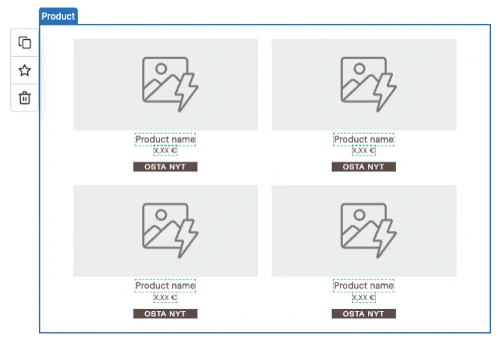
InMail Shop — Payload: 30kb

7. Insights
Limitation: No Reporting Klaviyo does not provide performance reporting for its product feeds. Its tracking is limited to basic click metrics and offers no visibility into what happens after a shopper clicks on a recommended item. This disconnect makes it impossible to assess true effectiveness or optimize based on real outcomes.
Next Level: Actionable Insights Email Pulse includes built-in analytics that go far beyond attributed revenue. It provides detailed reporting on the performance of personalized product streams, along with full campaign and flow analytics. This gives marketers the actionable insights they need to continually refine their strategies, improve targeting, and drive measurable results.
Competitive Advantage Each campaign generates a treasure trove of insights into customer needs and preferences—forming the foundation of a sustainable competitive advantage.
What You're Not Seeing in Klaviyo's Reports
Klaviyo provides basic email performance metrics—such as opens, clicks, and attributed revenue—but stops short of offering the deeper insights marketers need:
- There’s no visibility into how shoppers behave after clicking through to the online store.
- No way to measure the effectiveness of individual product recommendations.
- No reporting tied to lifecycle stages or shopper intent.
Without these insights, marketers are left with surface-level data and little ability to connect email activity to real outcomes.
Email Pulse: Closing the Gap Between Email and Ecommerce Data
Email Pulse was built to solve a critical blind spot in ecommerce marketing—the disconnect between email engagement and what happens next in the online store. While most email platforms stop tracking at the click, Email Pulse goes further by combining email metrics with onsite behavior, product interactions, and lifecycle data. This unified view gives marketers real insights into how shoppers respond to email-driven product recommendations, what drives conversions, and where opportunities are being missed.
Applying Uplift Modeling to Email Performance
Uplift modeling is a technique used to measure the true incremental impact of a campaign by comparing the behavior of those exposed to it with a similar group that wasn’t. Instead of simply tracking clicks or attributed revenue, it isolates what changed because of the campaign.
At Email Pulse, we apply uplift modeling to both entire email campaigns and the personalized product recommendations within them—measuring how each influences shopper behavior beyond the inbox.
In Summary
Personalizing the shopping experience is an incredibly complex challenge—one that requires advanced technology and deep behavioral understanding to solve effectively. Achieving the highest possible results demands the use of cutting-edge tools, including generative AI for ecommerce, to dynamically adapt to each shopper’s intent, preferences, and lifecycle stage.
Klaviyo provides a strong foundation, but if your brand is serious about competing—and winning—in today’s marketplace, we believe Email Pulse is the right next step.