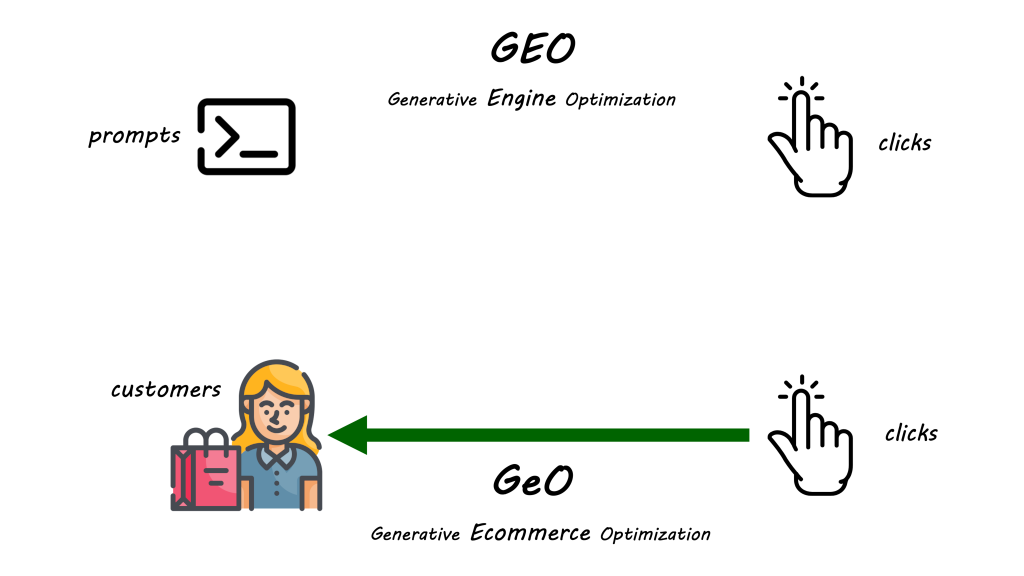
TL;DR: While everyone’s talking about how to leverage GEO—Generative Engine Optimization—GeO—Generative Ecommerce Optimization—is already delivering results. They’re two sides of the same coin: one brings the shopper in, the other shapes what happens next. You need both.
Introduction: A New Era for Ecommerce Begins
The wave of Generative Engine Optimization (GEO) is unmistakable. Tools like ChatGPT, Perplexity, Grok, and Gemini are quickly becoming the new starting points for product discovery, reshaping the way we search, research, and make purchase decisions online.
This AI-driven shift is undeniable—but it’s only half the story.
While GEO is bringing shoppers in through AI-powered discovery, there’s a new imperative emerging on the other side of the click: GeO—Generative ecommerce Optimization.
GeO and GEO are two sides of the same coin. GEO drives shoppers to your store; GeO shapes what happens next.
Without both working in harmony, ecommerce brands risk losing the very traffic AI is driving.
In this post, we’ll explore:
- Why traditional ecommerce funnels are no longer effective
- What GeO is and how it complements GEO
- Key components of GeO
- Real-world impact (e.g. Email Pulse)
- Practical Q&A for implementing each GeO component
The Shopper Journey Has Changed
Shoppers are no longer starting their product discovery journeys on Google. Instead, they’re asking AI tools direct questions like “What’s the best standing desk under $500?” or “Top-rated running shoes for flat feet?”
Generative AI tools respond instantly, linking to specific products, reviews, and brand pages. This new behavior disrupts search-engine-dominated discovery and undermines traditional SEO strategies.
But there’s a bigger problem: when the shopper clicks one of those links and lands on your site… nothing’s changed. The store experience looks and behaves like it did five years ago.
That’s where GeO steps in.
What Is GeO?
Generative ecommerce Optimization (GeO) is an AI-powered approach to optimizing the post-click ecommerce experience. Instead of relying on shoppers to discover products of interest on their own, GeO uses shopper profiles, product data, and real-time behavior to personalize what each visitor sees at every step of their journey.
It’s the next level in the personalization or CRO tech stack. It’s a framework built for an AI-powered world—where previously unimaginable amounts of highly fragmented data are collected, modeled, and used to detect visitor intent in real time.
The following is a high-level summary of the core building blocks to help explain what sets this technology apart from conventional generative AI applications.
1. Input: Prompts are replaced with customer actions.
Challenge: Generative AI tools like ChatGPT are driven by prompts. Ecommerce isn’t.
When shoppers land on your site, they don’t prompt you—they act. They click, scroll, abandon, or buy.
GeO captures and interprets these actions as buying signals.
Example: Instead of waiting for a shopper to use filters or search, GeO proactively and continually adapts based on the shopper’s actions.
Generative AI chat apps are more of the same. Yes, they’re technically more advanced—but still flawed. Today’s shoppers don’t want to type. If they don’t see what they need, it might as well not exist.
Q&A
Q: How do you track shopper actions? Shopper activity is typically tracked using web analytics and email platforms that capture landing pages, product views, add-to-carts, checkout start, purchases and a wide variety of other relevant user behavior actions.
Q: Can you access events tracked by third-party apps? Yes—if those events are pushed into the email platform. Good examples include events generated by loyalty programs or identity resolution tools like Retention.com, Customers.ai, Triple Whale, or Elevar.
Q: How can you access shopper events in real time? Our event listeners capture shopper activity data and store it on a high-performance endpoint, making it instantly accessible for real-time use by our solution.
2. Model: LLMs are replaced with clickstreams
Innovation: LLMs model and understand human language. GeO understands and generates clickstreams.
Every click is a word. Every session is a sentence. And the full clickstream tells the story of why a shopper does or doesn’t convert.
GeO decodes this stream in real time and uses it to serve the right products, to the right shopper, at the right time.
Example: A shopper hovers over hiking boots and then clicks away. GeO could immediately prioritize outdoor gear in the subsequent step of a buying journey.
Visitor actions are the strongest predictor of product needs. Conventional personalization solutions rely on customer profiles and past purchases to predict future behavior—essentially driving while looking in the rearview mirror. Amazon, with the world’s largest customer database, was among the first to recognize that what a shopper does during a buying session is a far better indicator of their current product needs than any historical data.
Q&A
Q: What’s the tech behind clickstream modeling? It’s a combination of analytics tools, AI-based session scoring, and pattern recognition engines.
Q: Is this only for large brands? No. Tools like Email Pulse make it accessible for mid-sized ecommerce stores.
3. Data: Static data is enriched with performance metrics
Advantage: LLMs rely on static data—product descriptions, tags, and specs. GeO focuses on performance: what gets clicked, what sells, what repeats.
It doesn’t just list what you have—it prioritizes what’s proven to work.
Example: Two products might have similar descriptions. GeO will show the one that converts better to the shopper segment in view.
Popularity Is Fool’s Gold. Relying on product popularity traps brands in a vicious, self-reinforcing loop. Products that are popular get promoted more, which drives even more perceived popularity. Meanwhile, high-converting or high-margin products get pushed aside. This cycle rewards volume, not performance—often at the expense of real business outcomes.
Q&A
Q: How do you identify top-performing products? It’s a combination of analytics tools metrics, AI-based session scoring, and pattern recognition engines.
Q: Can this replace merchandising? It doesn’t replace them—it acts as an AI agent that helps merchandisers supercharge their campaigns with data-driven offers.
4. Output: General is replaced with brand-specific
Difference: Generative AI uses all available data to provide general advice, while GeO uses only brand data to deliver brand-specific content.
It understands your unique product catalog, shopper prior actions, and performance metrics. It doesn’t guess — it knows.
Example: AI might generate a general list of “the best boots under $200,” while GeO delivers a personalized list based on the shopper’s prior actions and implied buying preferences.
Most shoppers — 95% — aren’t ready to purchase yet. They’re interested but still exploring. By continually surfacing relevant products, brands can stay connected and be remembered when the moment to buy arrives.
Q&A
Q: Does GeO require custom dev or integration work? Not necessarily. Tools like Email Pulse can easily connect with a merchant’s store, email, and analytics data.
Q: What makes GeO brand-specific? GeO is brand-specific because it trains its algorithmic models solely on data from a single brand. It continuously analyzes brand-specific email events, web clickstreams, product metadata, and web analytics to identify shopper needs and preferences.
Real-World GeO in Action: Email Pulse
GeO isn’t theoretical. It’s already in action.
Email Pulse is a tool that applies GeO methodology to ecommerce email marketing.
Instead of using emails as jump-off points to drive traffic to the online store, Email Pulse streams a mini version of the store—called InMail Shop—directly into emails in real time, featuring personalized product streams based on actual shopper behavior and store data.
The results:
- 30–40% more value captured from the same leads
- Higher engagement rates
- Better conversion across the lifecycle
No extra effort. No expensive dev work. Just GeO in action.
Final Thoughts: GeO Completes the Loop
GEO attracts. GeO connects and converts.
As Generative AI becomes the front door to your store, the post-click experience must evolve too. If not, you risk losing valuable traffic at the moment it matters most.
GeO makes sure your store speaks the same language as today’s shoppers—fast, adaptive, data-driven.
This is the next evolution of ecommerce optimization. Not someday. Now.