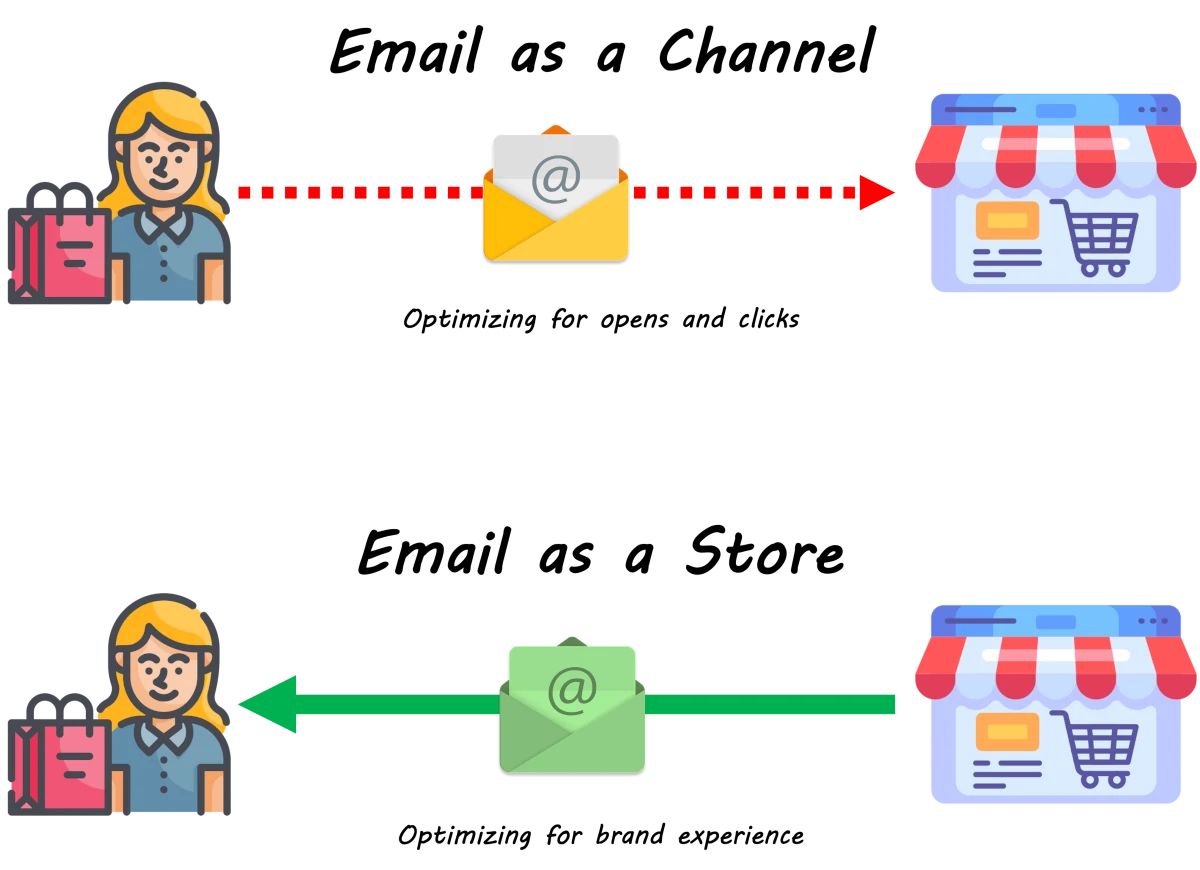
TL;DR: Most brands still treat email as a channel for driving traffic to the store. In the age of AI, the smartest ones treat email as the place where the store itself now lives.
Introduction — Why This Playbook
AI is transforming the core nature of email marketing.
What was once a performance-obsessed channel built to drive traffic is now becoming the most valuable owned real estate where ecommerce experiences actually happen.
This playbook offers a new perspective on the challenges you face at every stage of the shopper journey and shows how applying AI can deliver unmatched short and long-term performance.
Full disclosure: while it looks like a best-practices guide, this playbook is designed to give you the full context for why Email Pulse exists. It is the tool that makes AI transformation effortless with a simple drag and drop of one content block into your marketing emails.
Why Emails Aren't Printing Money Anymore
Email is still one of the most profitable channels in ecommerce. Top brands generate 25–35% of total store revenue through email alone.
But if you’re reading this, chances are your results are slipping. You’re sending campaigns, but:
- Open rates are dropping
- Click-throughs barely move
- Deliverability is inconsistent
- Spam complaints are creeping up
- Your list is getting stale
The truth is simple: your audience has changed faster than your approach.
Shoppers are more distracted, privacy tools are more aggressive, and inboxes are more crowded.
What used to work—blast campaigns, automated flows, batch-and-blast promos—no longer cuts through.
You may be sending more but getting less. You tweak subject lines, adjust send times, and test CTA buttons, yet results plateau.
This playbook is your practical guide to turning that around. It walks you step-by-step through diagnosing and fixing each stage of the email shopper journey, then shows you what comes next: a new era of ecommerce where data insights and AI-powered personalization make your work—and your brand—more valuable than ever.
Conventional Approach to Email Marketing
For most brands, email marketing still follows a familiar sequence: send a message → earn an open → drive a click → and hope for a purchase.
It is a system focused on traffic generation, offering little insight into what happens with that traffic once it reaches the online store.
This model worked when attention was abundant and shoppers moved neatly from inbox to website to checkout. Today, that model is breaking down in two fundamental ways.
First, the modern buying journey is highly fragmented. Google calls it the messy middle — a complex decision process that spans multiple touches, multiple sessions, and multiple stores before a purchase is made.
Second, analysis of thousands of marketing campaigns has revealed what is now known as the 95/5 rule of marketing. Only about 5% of your ideal customer profiles are actively in buying mode at any given time. The other 95% are not ready to purchase, no matter how persuasive your discounts or creative offers may be.
Unfortunately, most marketers respond by doing more of the same:
- Testing subject lines to lift open rates
- Adjusting send times to chase engagement windows
- Redesigning CTAs to nudge click-through rates
Yet despite all this effort, performance often plateaus or even declines because these actions do not address the root cause of the problem.
The AI Way
Artificial intelligence is transforming the role of the performance marketer into that of a brand experience marketer. It is also transforming the role of email from a source of traffic into a valuable piece of digital real estate where the ecommerce experience actually happens.
AI has an unmatched ability to process fragmented data and drive performance automatically, which frees marketers to focus their creativity and talent on building what matters most — brand experience.
When you combine AI-powered performance management with a strong brand experience, you create the winning mix that consistently delivers top results.
Since 95% of your ideal customers are not in buying mode, it makes little sense to focus only on the few who are clicking. Marketers should pay disproportionate attention to the non-buyers — the majority of their audience who are not yet ready to visit the store.
The concept is simple: if they are not ready to click and come to your store, bring the store directly into their emails.
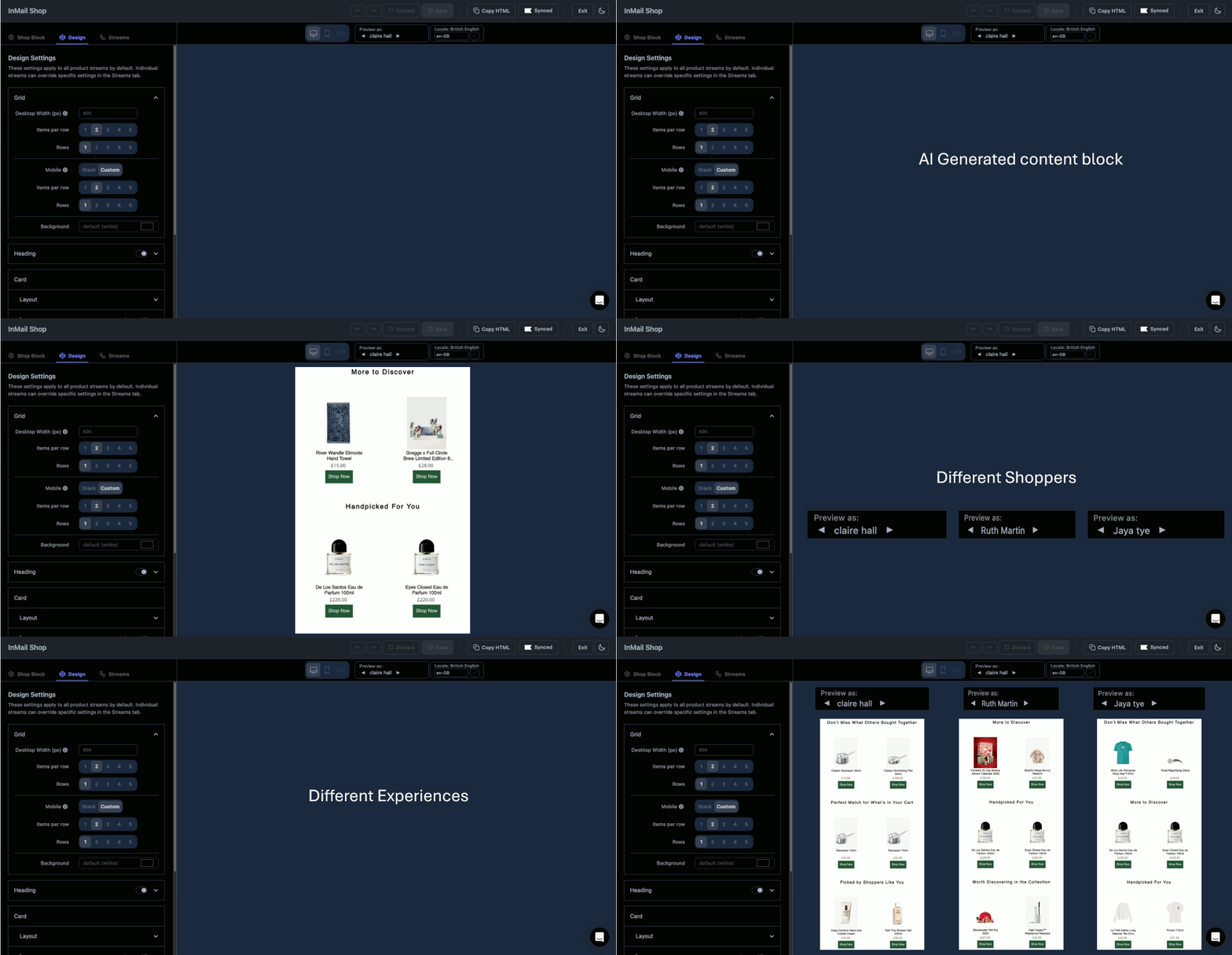
AI solves this by generating a mini version of your store that is highly relevant to each shopper’s prior interactions with your brand. Instead of relying on open rates and click-throughs as the only signals of interest, AI enables you to read intent directly from shoppers’ in-store behavior and context.
The inbox becomes the most valuable real estate your brand owns — a destination where personalized products, collections, and stories are streamed directly to each subscriber.
The Buying Journey — The Messy Middle
Every shopper moves through a series of consideration points before making a purchase. These cycles are rarely sequential. They often involve multiple store visits, interactions across different channels, and moments of hesitation before a final decision is made. Google calls this fragmented process the messy middle.
Think of the email buying journey as a connected system of five stages:
| Funnel Stage | Metric to Watch | Common Problems | Impact on Revenue |
|---|---|---|---|
| 1. Deliverability | Inbox placement | Weak sender reputation, spam filters, outdated lists | Emails never seen |
| 2. Open Rate | Percentage opened | Subject fatigue, poor timing, irrelevant targeting | Lost attention early |
| 3. Click-Through Rate | Percentage clicked | Non-relevant products, weak CTAs, design friction | Traffic drop-off |
| 4. Conversion Rate | Percentage purchased | Poor product match, low engagement, checkout friction | Missed revenue |
| 5. Retention | Reopens, repeat purchases, list churn | Fragmented identity, cookie expiration, disengagement | Lost lifetime value |
Traditional email tools and marketing methods are no longer a match for this increased complexity.
Performance Benchmarks — Set Your Targets
| Metric | Average Store | Top 10% Performers | Target Range |
|---|---|---|---|
| Open Rate | 25–30% | 45–55% | 40%+ |
| Click-Through Rate | 2–3% | 4–6% | 4%+ |
| Deliverability | 88–92% | 96–98% | 95%+ |
| Spam Complaints | 0.1–0.2% | <0.05% | <0.05% |
| Revenue per Email | $0.25–$0.50 | $1.50–$3.00 | $2.00+ |
| Repeat Purchase Rate | 10–20% | 25%+ | 20%+ |
| List Churn | 4–6% | <3% | <3% |
Use benchmarks as a diagnostic tool. They reveal where your system is leaking value and where applying AI-enhanced methods can deliver the biggest improvement.
Fix #1 — Improve Deliverability
Most established brands already have a reliable technical setup. Yet even with a clean setup, deliverability scores often slip. The silent culprit is not DNS or infrastructure — it is list fatigue.
Over time, subscribers disengage. They stop opening, stop clicking, and quietly become dead weight on your list. These inactive contacts drag down engagement metrics, reduce sender reputation, and gradually limit inbox placement for everyone else.
Simply deleting these contacts is not a viable solution. Growing a qualified email list is expensive and time-consuming, and once someone is removed, reactivating them later is nearly impossible.
How AI Helps
AI can monitor subtle changes in subscriber behavior to predict when someone is on the path to disengagement. Instead of reacting after the damage is done, AI detects early warning signals such as decreased click frequency, shorter engagement windows after campaigns, lower interaction depth within product blocks, and reduced browsing activity following email opens.
Once these signals are detected, AI can automatically trigger preemptive re-engagement events before the subscriber goes cold — delivering dynamic content that aligns with the shopper’s latest browsing history, adjusting message cadence to reduce fatigue, and initiating a personalized win-back flow only for those most likely to respond.
Fix #2 — Increase Open Rate
Every subscriber on your list, by opting in, has already shown interest in your brand and is inclined to open your emails. The key is maintaining that interest.
Open rates decline when ongoing emails fail to deliver meaningful brand experiences. Even if shoppers are not clicking — and 95% are not ready to buy — the experience you create for those who do open determines whether they will open again.
Each open is an opportunity to reinforce brand value. When every email feels fresh, relevant, and visually engaging, shoppers continue to see your messages as worth their attention.
AI strengthens this connection by bringing the store directly into the inbox. It streams a personalized mini version of your store inside each email, showcasing products and collections that align with each shopper’s past behavior and interests.
This approach keeps your brand top of mind, preserves engagement among non-buyers, and ensures your emails remain something shoppers look forward to opening.
Fix #3 — Boost Click-Through Rate
When CTR falls, most marketers reach for the same levers: redesign the email, tweak the CTAs, test new layouts. When these changes stop moving the needle, the next step is often desperate — using deeper discounts to force short-term sales.
Lower prices may push a few shoppers who were already close to buying, but this approach erodes margins and conditions your audience to wait for the next deal. For the 95% who are not ready to buy, constant discounting does nothing.
The real issue is not design or pricing. It is relevance. Shoppers click when what they see feels connected to what they want.
How AI Changes the Game
AI solves the relevance gap by bringing the store experience into the email itself. Instead of sending generic offers, AI streams a personalized mini version of your store inside every message — analyzing each shopper’s browsing and purchase history, product preferences, and engagement patterns to decide what to display.
This delivers two outcomes: higher CTR today for the small segment of shoppers who are ready to buy, and pent-up demand tomorrow for the larger group who are not yet ready to purchase but are building brand familiarity.
Fix #4 — Improve Conversion Rate
For most email marketers, what happens after a shopper clicks an email link is a black box. The email platform tracks opens and clicks, but once the traffic reaches the online store, visibility ends.
Why It Fails
- Poor landing page selection — Brands rely on high-traffic pages rather than high-RPV (Revenue Per Visit) pages.
- Poor product selection — Brands feature best sellers by volume rather than those that convert best within each campaign or audience segment.
- Poor discovery experience — Shoppers often explore related items before deciding. Guiding them from one relevant product to another is the true conversion multiplier.
How AI Solves It
AI identifies which collections, categories, and products generate the highest RPV and conversion rates. By streaming a personalized version of the online store into each email, AI enables product discovery before the shopper even visits the site — meaning when shoppers do arrive, they are already more informed and closer to purchasing.
Fix #5 — Retention
Retention is not a final step in the funnel. It is the unifying objective behind every stage of the buyer journey.
Why Retention Fails
- Data fragmentation — Shopper behavior is scattered across devices and channels, breaking continuity.
- Static automation — Most flows deliver the same content to everyone, regardless of interest or recency.
- Poor product focus — Brands highlight best-selling items rather than products that keep customers engaged and coming back.
How AI Strengthens Retention
AI helps marketers turn retention into an active, measurable strategy by continuously recognizing shoppers across sessions, responding to live intent with dynamic retention flows, identifying products that consistently drive repeat engagement, and streaming a personalized mini-store into retention emails to maintain curiosity and brand connection.
Retention is the outcome of relevance. When each interaction feels timely and connected — powered by products and experiences proven to hold attention — your audience remains active longer, opens more often, and buys more frequently.
Summary
Most marketers still view email through the lens of optimization. They tweak subject lines, test CTA colors, or adjust send times. These steps have value, but they only improve the mechanics of communication.
What truly drives performance today is transformation — rethinking what email marketing is.
Email is no longer just a traffic channel. It has become the most valuable digital real estate your brand owns.
The five fixes in this playbook all lead to the same goal: retention.
- Better deliverability keeps your list alive.
- Stronger open rates maintain attention.
- Higher click-through rates deepen engagement.
- Improved conversion rates turn attention into sales.
- Continuous retention keeps the relationship growing.
AI unites these steps by adding what traditional marketing systems cannot — relevance at scale.
In the age of AI, success belongs to brands that transform email from a sending tool into an always-on storefront — one that drives performance today and builds retention for tomorrow.
Act Now
Apply AI to your email campaigns with a single drag-and-drop content block and start gaining all the benefits described above from day one.