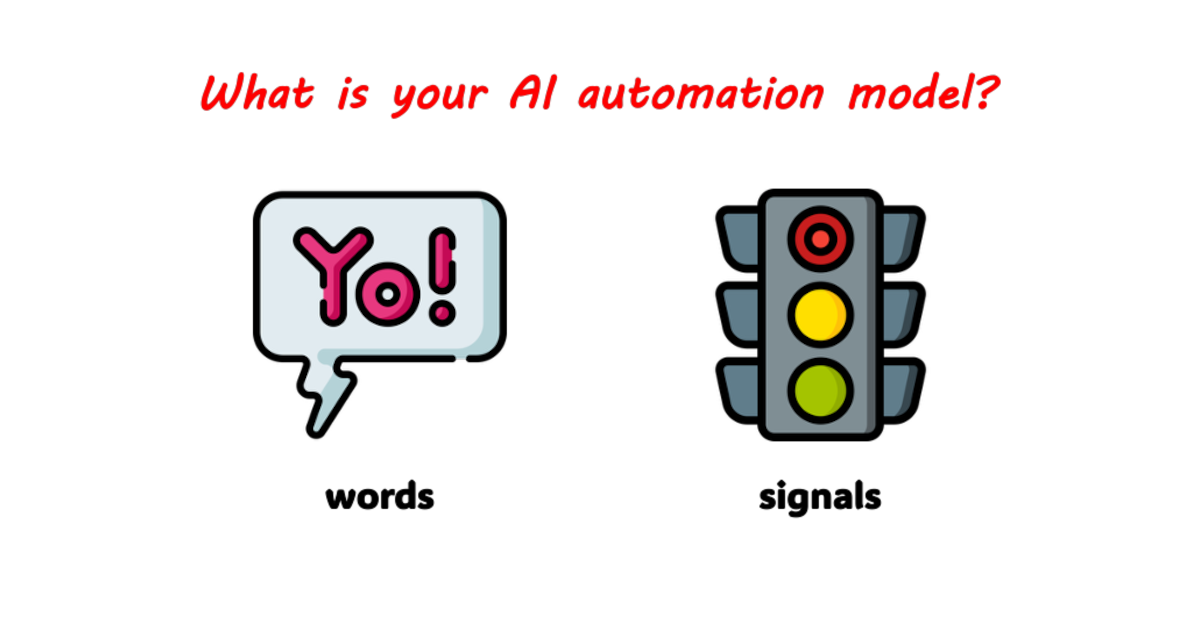
Large language models are extraordinary at generating language. They can summarize. They can translate. They can explain performance trends. But business systems are not language problems. They are signal problems. And signals must be engineered before automation becomes reliable.
LLMs Understand Language. They Do Not Understand Your Business.
Large language models are trained on massive volumes of text. They predict what words are likely to come next. They do not inherently understand your revenue baseline, your lifecycle structure, your attribution logic, your margin sensitivity, or your seasonality.
Without modeling, AI interprets surface metrics — not business reality. That distinction becomes critical when building any AI automation system on top of Klaviyo data.
Data Describes. Signals Decide.
Most dashboards display descriptive metrics: open rate, click rate, revenue per recipient, conversion rate. These metrics tell you what happened. They do not define what should happen next.
A 38% open rate may be strong. It may also signal underperformance relative to historical incremental impact. Without defined baselines and classification logic, AI cannot reliably determine whether action is required.
That is why automation-ready AI depends on structured performance signals — not raw metrics. The Klaviyo AI Companion exists specifically to bridge this gap, transforming raw Klaviyo data into structured, decision-ready signals before AI reasoning begins.
Why Probabilistic AI Struggles in Automation
Large language models are probabilistic systems. The same dataset can produce slightly different explanations depending on prompt wording, session context, and tool invocation order.
In reporting, this variability is tolerable. In automation, it creates instability. Automation requires consistent interpretation, stable thresholds, and repeatable decision pathways. Without modeling, even advanced AI workflows remain fragile.
Modeling Transforms AI from Analyst to Operator
Modeling translates metrics into structured signals. Instead of asking “Is this campaign performing well?” — modeling asks “Is this campaign underperforming relative to its incremental lifecycle baseline?”
That shift creates defined classifications, decision-ready indicators, controlled intervention triggers, and repeatable automation logic. This is what separates experimentation from true AI decision-making systems.
Email Marketing Makes the Limitation Visible
In Klaviyo, AI can retrieve data easily. But retrieving data is not the same as producing reliable automation. Different brands have different revenue baselines, different customer lifecycles, different engagement distributions, and different performance ceilings.
Without modeling, AI treats every account as statistically similar. That assumption breaks automation at scale. It is why agencies running AI automation across multiple Klaviyo accounts need a structured intelligence layer above the data — not just raw MCP access.
Smarter Models Do Not Replace Structured Systems
Better prompts do not eliminate variability. More advanced models do not replace defined baselines.
As organizations move from experimentation to automation, they discover a consistent truth: language models generate explanations. Modeled systems generate actions.
Without engineered signals, AI describes performance. With them, AI executes. That is the difference between access and operational intelligence.
FAQs
Why do large language models need data modeling in business automation? Large language models understand language patterns, not business baselines. Modeling converts raw metrics into defined signals that enable consistent automation decisions.
What is AI automation modeling? AI automation modeling structures performance data into classifications, thresholds, and lifecycle-aware signals that AI systems can interpret consistently when triggering workflows.
Why are metrics alone not enough for automation? Metrics describe what happened. Automation requires decision-ready indicators that determine whether intervention is necessary based on historical and lifecycle context.
Why does AI produce inconsistent insights without modeling? Because large language models are probabilistic. Without structured baselines and guardrails, interpretations can shift depending on prompts or session state.
How do signals improve AI decision-making systems? Signals convert descriptive data into structured indicators aligned with business logic. This creates repeatable automation pathways instead of prompt-dependent analysis.
What are AI automation signals? AI automation signals are structured performance indicators derived from raw metrics. They represent decision-ready insights that determine when systems should trigger actions, adjust workflows, or intervene automatically.
How are signals different from metrics in AI systems? Metrics describe what happened. Signals interpret whether action is required. Signals incorporate baselines, lifecycle context, and thresholds, while metrics are purely descriptive.
Can AI create signals automatically without modeling? No. AI can analyze and summarize data, but signals must be engineered through modeling frameworks that define baselines, classifications, and intervention logic. Without modeling, outputs remain interpretation-based rather than action-based.
Why do AI automation systems fail without structured signals? Without structured signals, AI outputs vary depending on prompts and context. This inconsistency makes automation fragile and unreliable, especially across multiple accounts or brands.
How do AI automation signals improve performance in email marketing? By converting engagement and revenue metrics into decision-ready indicators, signals allow automation systems to act based on incremental impact rather than surface metrics. This improves consistency, scalability, and optimization outcomes.