Over the past decade, marketing technology has progressed in stages. Each stage solved one limitation. Each stage revealed the next bottleneck. We are now entering a new phase. But to understand where we are going, we need to understand where we have been.
Phase 1: Dashboards
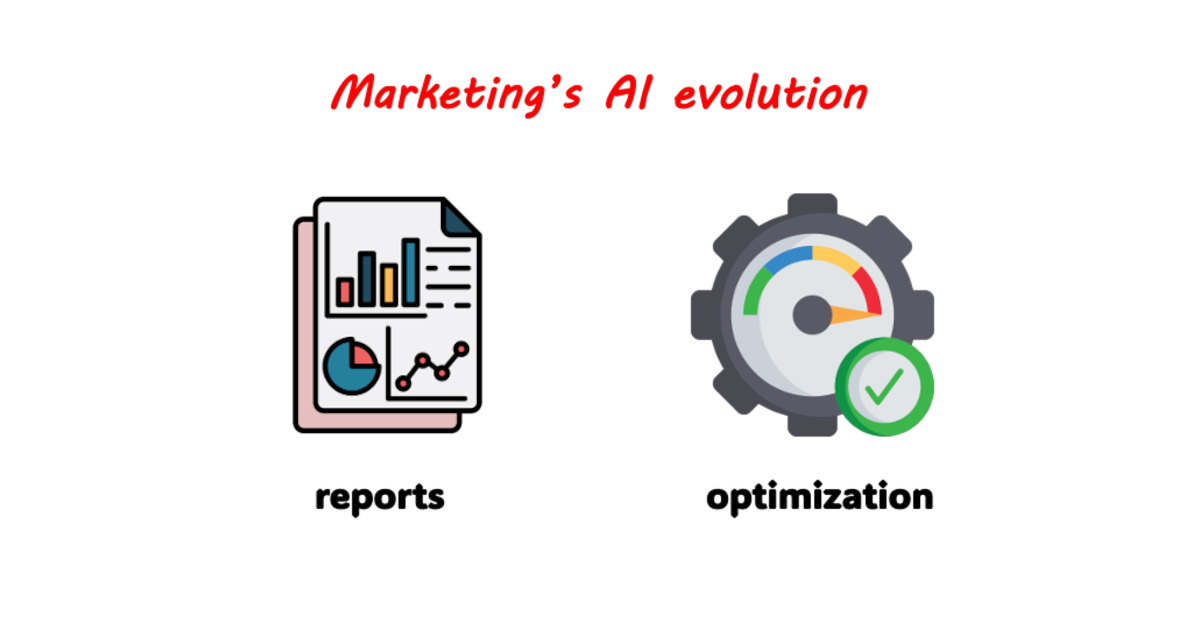
Marketing platforms began with dashboards. Metrics became visible — open rates, revenue, conversion rates, traffic. Dashboards improved transparency. But they did not create action. Humans still interpreted metrics manually.
Phase 2: Automation
The next leap was rule-based automation. Triggered flows. Segment logic. Behavior-based emails. Automation reduced manual effort. But it relied on predefined conditions. It executed rules. It did not reason.
Phase 3: AI Access
The introduction of large language models changed the landscape. With MCP connections and API integrations, AI could retrieve campaign data, analyze flows, generate summaries, and suggest optimizations. This was the first step toward AI-driven marketing.
But access alone is not intelligence. Without structured modeling, AI explanations remained linguistic — not operational. This is the gap that separates teams experimenting with AI from teams operating it reliably.
Phase 4: Intelligence Layer
The next phase introduces structured reasoning. An intelligence layer embeds scientific scoring, lifecycle modeling, signal extraction, governance controls, and versioned interpretation logic.
AI no longer “explains metrics.” It evaluates performance against defined business standards. This is the foundation of AI automation modeling. The intelligence layer transforms access into decision logic — and decision logic is what makes automation safe, consistent, and scalable.
Phase 5: Autonomous Optimization
When structured signals drive consistent decision pathways, automation evolves again. Optimization becomes continuous, signal-driven, threshold-governed, and cross-account scalable.
This is not reactive automation. It is autonomous optimization — not in the sense of replacing marketers, but in the sense of detecting performance shifts, triggering pre-approved workflows, maintaining governance, and operating consistently. This is the emergence of AI decision-making systems.
The Industry Shift
The progression is clear:
- Dashboards → Visibility
- Automation → Execution
- AI Access → Analysis
- Intelligence Layer → Structured Reasoning
- Autonomous Optimization → Continuous Performance Systems
The companies that win will not be those who experiment with AI. They will be those who systematize it. This is the macro transition from tools to operating systems.
Why This Matters Now
Every new technology wave follows the same pattern: early adopters focus on access, mature operators focus on structure. AI in marketing is crossing that threshold.
The competitive advantage is shifting from “Who uses AI?” to “Who has structured AI operating logic?” That is the difference between novelty and leverage.
FAQs
What is the evolution of AI in marketing? Marketing has progressed from dashboards to automation, AI access, intelligence layers, and now autonomous optimization. Each phase solved the bottleneck of the previous one — and each revealed a new one that required a more structured approach.
What is an intelligence layer? An intelligence layer embeds structured scoring, lifecycle modeling, and governance into AI systems. It sits between raw data access and AI reasoning, transforming metrics into decision-ready signals before interpretation begins.
What is autonomous optimization? Autonomous optimization uses structured signals and predefined logic to continuously improve performance. It detects shifts, triggers pre-approved workflows, and maintains governance — without requiring manual intervention for every decision.
How is AI access different from AI intelligence? AI access retrieves data. AI intelligence evaluates performance using structured modeling and defined thresholds. Access is the input layer. Intelligence is what determines whether that input produces reliable outputs.
Why are dashboards insufficient today? Dashboards show metrics but do not generate consistent, automation-ready decisions. They require human interpretation at every step — which creates bottlenecks, inconsistency, and scaling limits.
What replaces rule-based automation? Signal-driven, model-governed automation systems. Instead of triggering on hardcoded conditions, these systems evaluate performance signals against dynamic baselines and lifecycle-aware thresholds.
Why is structured reasoning important? It ensures consistent and reliable performance interpretation across teams and accounts. Without structured reasoning, AI outputs vary based on how questions are phrased — making automation unreliable.
Are autonomous systems replacing marketers? No. They enhance performance consistency while preserving strategic control. Marketers define the strategy, the thresholds, and the governance rules. Autonomous systems execute within those boundaries reliably.
What defines AI maturity in marketing? Centralized modeling, scientific scoring, governance, and scalable automation logic. Maturity is measured not by how many AI tools are connected, but by how consistently and reliably those tools operate across environments.
What is the future of AI in email marketing? AI-first operating systems that combine LLM intelligence with structured domain expertise. The future belongs to teams that have built the intelligence layer — not just connected the models.