TL;DR: Brands rush to adopt AI. Almost none fix the foundational setup AI depends on. Segmentation comes first.
Download: Segmenting Rules @ Google Docs
Introduction — Why AI Needs a New Segmentation System
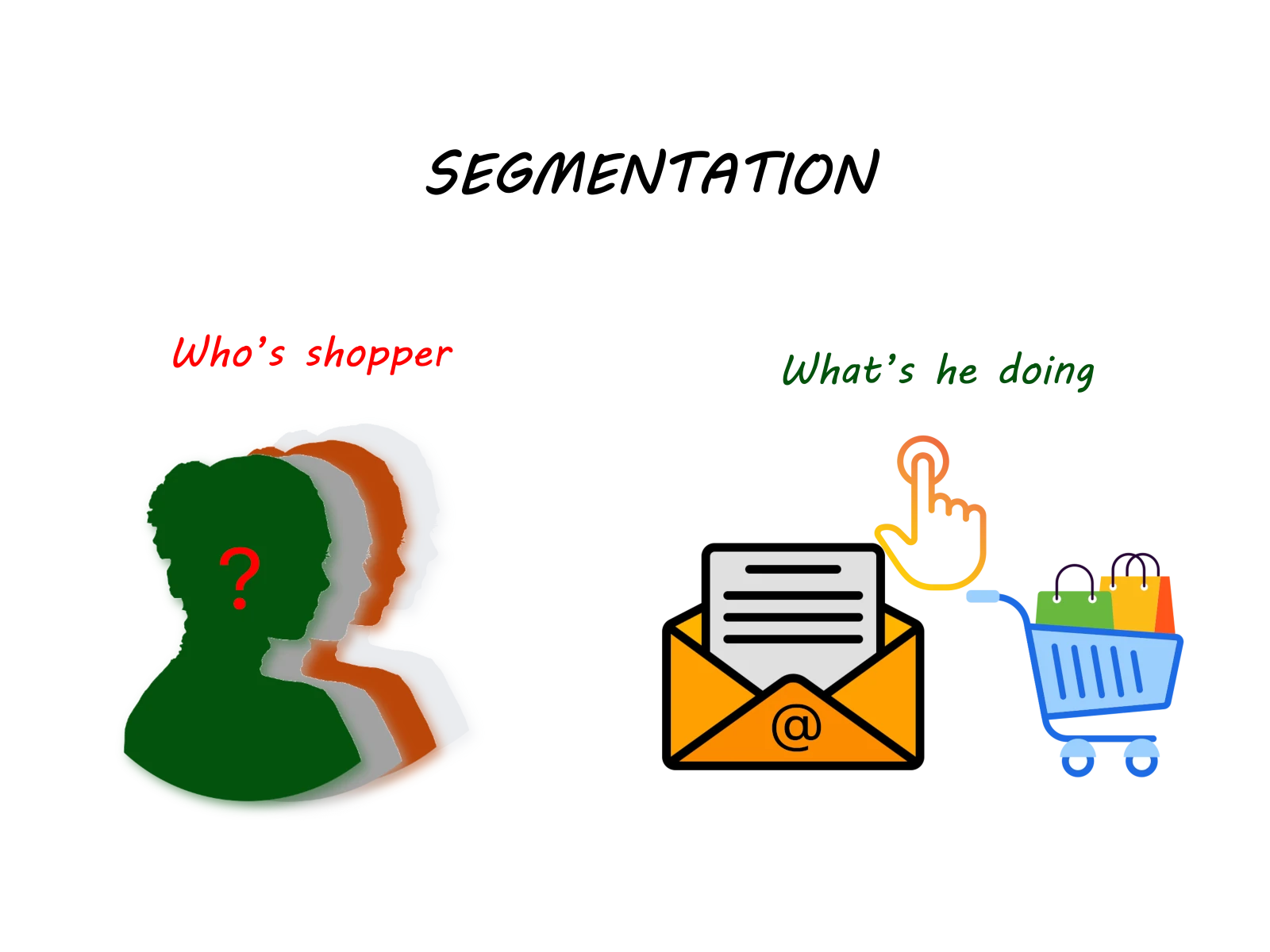
Most brands still segment their email lists based on who shoppers are or what they bought in the past.
These approaches made sense when email was primarily a traffic generation channel.
They do not scale in a world where automation, personalization, and AI agents are expected to make intelligent decisions on behalf of marketers.
AI does not fail because models are weak. AI fails because the systems feeding it fail to provide actionable data.
Overlapping segments, static lists, and non-deterministic rules produce conflicting signals. Conflicting signals break automation.
Broken automation leads to spam, missed opportunities, and gradual list decay.
There is a need for a segmentation system that:
- scales cleanly as lists grow
- benefits marketers even without AI
- produces deterministic, machine-readable signals
- enables AI agents to act with confidence
This playbook introduces AI-first Journey Segmentation: a behavior-based, stateful segmentation system designed to power both human decision-making and automated execution.
The Old Way
Segmenting by Who the Contact Is
Traditional email segmentation is built around contact attributes:
- demographic or profile properties
- declared preferences
- historical purchase data
- lifetime value tiers
- static tags and lists
While useful in isolation, these segments share fundamental flaws.
Core limitations of the old approach:
- Segments overlap — A single contact can qualify for many segments at the same time.
- Segments are static — They describe what happened, not what is happening now.
- Signals are non-deterministic — Automation cannot reliably decide which message or action should win.
- Scale creates chaos — As lists grow, segmentation complexity grows faster than human oversight.
The outcome is predictable:
- some contacts receive too many messages
- others receive none
- engagement decays quietly
- marketers compensate with more campaigns, urgency, and discounts
This is not a creative problem. It is a systems problem.
The New Way
Segmenting by What the Contact Is Doing
AI-first Journey Segmentation replaces static attributes with observable behavior.
Instead of asking “Who is this contact?” we ask “What is this contact doing right now?”
This approach treats segmentation as:
- stateful rather than static
- behavioral rather than descriptive
- deterministic rather than probabilistic
Contacts move through buying journeys, and within each journey they occupy a current state based on their most recent actions.
This model:
- scales naturally
- prevents overlap by design
- reflects real buying intent
- works equally well for humans and machines
Importantly, this system delivers value even without AI. AI simply amplifies its impact.
Core Journey Segmentation Concepts
This section defines the foundational concepts that make the system coherent and scalable.
Global Emailable Universe The global emailable universe includes all contacts who are eligible to receive email. This is the top-level population from which all journeys and cohorts are derived.
Journeys vs Lifecycle States
- A journey represents a macro intent context. Example: pre-purchase, first-time buyer, repeat buyer.
- A state represents the most recent position within that journey. Example: opened email, viewed product, added to cart.
Every contact belongs to one and only one journey, and one and only one state within that journey.
Mutual Exclusivity Mutual exclusivity is non-negotiable. Journeys must be mutually exclusive. States within a journey must be mutually exclusive. This guarantees no overlap, no conflicting signals, and deterministic automation inputs.
Behavior-Driven States States are defined by observable actions such as email interactions, site activity, and commerce events. States are ordered and inclusive downward — a higher state implies all lower states have occurred, and only the highest valid state is assigned at any moment.
Time as a First-Class Input Journey segmentation is time-aware. Three time concepts govern classification:
- Rolling window — Determines what matters now. Used to assess current activity.
- Look-back window — Used for analysis and context.
- Grace period — Prevents premature drop-off and excessive churn between states.
Active vs Passive Cohorts Within every journey, contacts are split into:
- active cohort: recent qualifying behavior within the rolling window
- passive cohort: no qualifying behavior, but still logically part of the journey
Passive does not mean inactive or lost. It means “not currently progressing.”
Global Journey
System-Level Segmentation
The Global Journey view classifies every emailable contact into a journey and an activity cohort (active or passive).
Why this matters Most brands cannot answer a simple question: “Where is my email list actually stuck?”
The global view:
- exposes distribution imbalances
- highlights drop-off zones
- surfaces silent decay early
- reconciles total emailable vs engaged populations
How it works All emailable contacts are grouped into journeys and cohorts using consistent rules. No contacts are orphaned. No contacts belong to multiple journeys.
What marketers gain
- big-picture list health visibility
- diagnostic insight without dashboards
- a clean input layer for AI agents
- confidence that automation is acting on truth, not noise
Buying Journeys
Macro Segments Based on Buying Context
Each buying journey represents a fundamentally different intent environment. Journeys are not marketing labels. They are system partitions.
New Subscribers Contacts who have opted in but have not yet demonstrated buying intent.
Active cohort: recent email engagement within the rolling window. Passive cohort: subscribed but not engaging recently. Purpose: warming, trust building, intent discovery.
Pre-Purchase Contacts who have demonstrated buying interest but have not purchased.
Active cohort: recent site or email behavior indicating interest progression. Passive cohort: historical interest without recent activity. Purpose: reduce friction, surface relevant products, move toward first purchase.
One Purchase Contacts who have completed exactly one purchase.
Active cohort: recent engagement or post-purchase interaction. Passive cohort: first-time buyers with no recent activity. Purpose: accelerate second purchase, prevent decay after initial conversion.
Repeat Purchases Contacts with multiple purchases who demonstrate ongoing buying behavior.
Active cohort: recent purchase or engagement activity. Passive cohort: repeat buyers with no recent activity. Purpose: increase order frequency, deepen loyalty, expand product discovery.
Active vs Passive Cohorts
The Missing Half of Most Segmentation Systems
Most segmentation systems focus only on “active” users. This hides reality.
Passive cohorts:
- explain where growth stalls
- reveal friction points
- represent the largest opportunity pools
Passive is not a failure state. It is a diagnostic state.
For AI agents, passive cohorts are critical:
- they define where intervention is needed
- they prevent blind optimization on only high performers
- they enable re-activation strategies driven by evidence
Ignoring passive cohorts leads to biased automation.
Why Journey Segments Are Gold for AI Agents
AI agents require clean, deterministic inputs. Journey-based segmentation provides exactly that.
With this system, AI agents can:
- detect friction between states
- identify abnormal drop-offs
- recommend flow adjustments
- prioritize cohorts by impact
- execute actions without human micromanagement
Humans define strategy. Journeys define structure. AI agents execute with precision.
Journey segmentation is not an optimization tactic. It is the operating system AI runs on.
FAQs
Is this only useful for teams using AI agents?
No. Teams benefit immediately from clearer visibility into list health, funnel friction, and engagement decay. AI agents simply accelerate and scale what strong operators already do manually.
Journey-based segmentation is valuable on its own. AI turns it into a force multiplier.
How is journey-based segmentation different from traditional segmentation?
Traditional segmentation groups contacts based on attributes or past outcomes. Journey-based segmentation classifies contacts based on their current behavior and position in the buying journey.
Instead of asking who a contact is, this system asks what the contact is doing now. The result is a stateful, deterministic model where every contact belongs to one journey and one state at any moment, with no overlap.
Does this replace demographic, RFM, or profile-based segments?
No. It replaces them as the primary execution layer, not as supporting signals.
Profile attributes, RFM scores, and preferences still matter, but they work best when layered on top of a journey framework. Journey segmentation determines when and why to act. Profile data helps refine how to act once the context is clear.
Why is mutual exclusivity so important?
Mutual exclusivity eliminates ambiguity. When a contact belongs to multiple segments at the same time, automation cannot reliably decide which action should take priority. This creates conflicting messages, over-mailing, or inaction.
AI systems require deterministic inputs. One journey and one state per contact ensures that every decision has a clear execution path.
Does every contact belong to a journey?
Yes. In this model, journeys are designed to partition the global emailable universe. Every emailable contact belongs to exactly one journey at any point in time.
Within that journey, each contact is also classified into one cohort (active or passive) and one current state (the highest valid state reached).
This ensures full coverage, no overlap, and deterministic inputs for automation and AI agents.
Can this be implemented using standard email platforms?
Yes. Journey-based segmentation is designed to work within the constraints of modern ESPs like Klaviyo, using existing events, properties, and time-based conditions. It does not require custom tracking or proprietary data to function.
The value comes from structure and logic, not from new data sources.
How does this improve automation outcomes?
Automation improves when signals are clear. With journey segmentation:
- flows trigger based on intent, not guesswork
- conflicts between campaigns are reduced
- drop-offs become measurable
- prioritization becomes systematic
AI agents can then monitor journeys, detect anomalies, and recommend or execute actions without constant human intervention.
What is the difference between active and passive cohorts?
Active cohorts include contacts showing qualifying behavior within a defined rolling window. Passive cohorts include contacts who still belong to a journey but are not currently progressing.
Passive does not mean disengaged or lost. It means stalled. Passive cohorts are where friction, drop-off, and reactivation opportunities live, and they are critical for both diagnosis and automation.
Try Email Pulse
Apply AI to your email campaigns with a single drag-and-drop content block and start gaining all the benefits described above from day one.